Top five… in South-East Asia

23 04 2010

There are now two weeks since we were in South East Asia and we have had a little time to digest all the things we did and all the memories that we created.  Therefore I decided to create a few “top five” lists.

Top five places we visited in South East Asia

  1. Angkor Wat (Cambodia) and the surrounding temples – just stunning
  2. Ko Phangan (Thailand) – the beaches and the sunshine and the food – what more do you want?
  3. Halong Bay (Vietnam) with its 2,000 limestone islands and relaxing cruises
  4. The Cham towers in Nha Trang (Vietnam) had a deep impact on me
  5. Dalat (Vietnam) and surroundings – great relive from the heat

Top five activities we did in South East Asia

  1. Mahout elephant training close to Luang Prabang in Laos
  2. Snorkeling in Ko Phangan in Thailand and Nha Trang in Vietnam
  3. Thai cooking class in Chang Mai, Thailand
  4. Zip wire ride with Jungle flight in Chang Mai, Thailand
  5. Tubing in Vang Vieng, Laos

Top five foods that we ate in South East Asia

  1. Thai red curry with rice – hot and yummy
  2. Fried coconut pudding (Thai sweetmeat coconut) – so delicious
  3. Tom Yum soup with shrimps – will be a regular back home
  4. Cambodian amok – a more subtle curry than the Thai curry
  5. Vietnamese shrimp spring rolls – they melt in your mouth

Top five disappointments/annoyances of South East Asia

  1. Theft on Thai busses (Bangkok to Surat Thani)
  2. Plastic garbage laying around almost everywhere
  3. Loud traffic in Vietnam and drivers unnecessarily honking their horns at us
  4. Annoying and pushy tuktuk drivers everywhere except in Laos where they are too laid back to be bothered
  5. Expensive and ultra touristy Andaman coast

We have done some much in the past three months that I’m sure that I’m forgetting something.


Blue Ocean Strategy: How to Create Uncontested Market Space and Make Competition Irrelevant by W.C. Kim & R. Mauborgne

23 04 2010

blue_ocean Sophisticated models and analytical tools that assist in the creation of a corporate strategy in contested markets have been around for a while.  These models and tools help create what the authors of the book call “red ocean” strategies where the focus is on competing within the current market boundaries by monitoring the competition and seeking either differentiation of products and services or cost leadership.

“Blue oceans” however are new uncontested markets where the competition is weak or none existent and therefore irrelevant.  The reason that only a few companies are able to open up those uncontested markets, according to the authors, is the focus on red ocean strategies in the strategy process.

In this book the authors set forth analytical tools to help companies structure their strategy process in a way that can lead to the opening of highly profitable blue oceans.

I thought that the idea of blue oceans is rather straight forward and common sense stuff.  However it is valuable to see the idea formulated into a thorough process that can be easily emulated during the strategic process within companies.  I agree with the authors that companies must have capabilities in both red and blue oceans in order to reach excellence – otherwise they will never break out of the boundaries set by their perspective industries.

I found the book to be an easy read and a bit thin at times.  The examples in the book were quite interesting but I often get the feeling that you can always find examples to support any theory if you search hard enough.  I’m sure someone could show that Apples success is due to the fact that the employees wear jeans to work or that Microsoft is so successful just because a lot of their employees wear glasses.

But anyway, I thought it was an interesting book and would surely recommend it to anyone interesting in strategy and innovation but for the rest of you – just wait for the movie!

Previous book reviews can be found here.


Shanghai to Hangzhou

22 04 2010

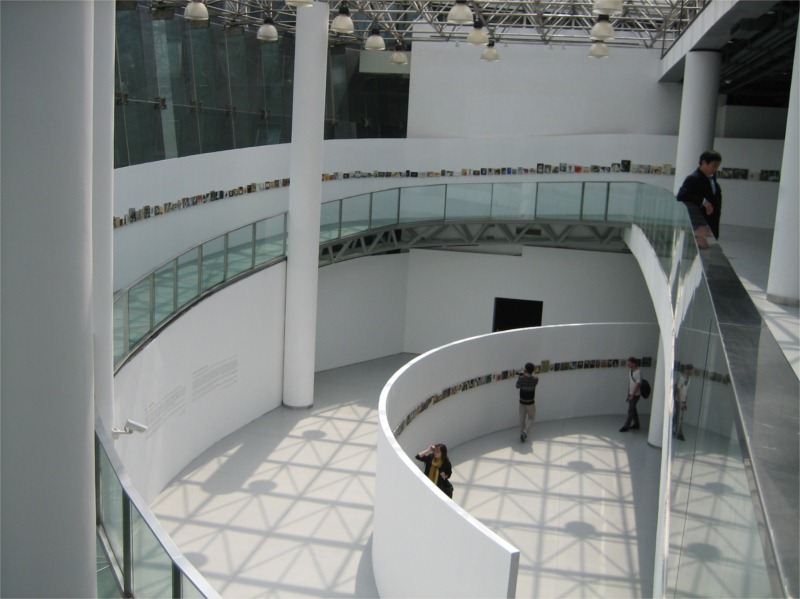
We spend the last days in Shanghai just wandering around the city center, checking out the stores in the French Concession and the skyline of the Bund.  We didn’t really do much in Shanghai in the sense of seeing places – more just went with the flow, which was a very nice change.  The only museum or site we visited was the Museum of Contemporary Art. 

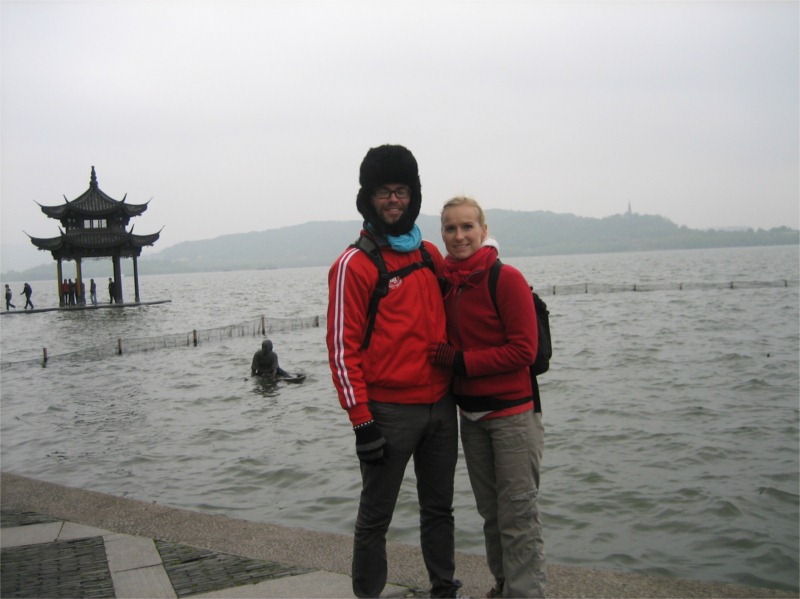
From Shanghai we took the very modern and fast fast-train to Hangzhou (180 km. in 80 minutes), described by Marco Polo as "beyond dispute the finest and the noblest in the world."  The city has a total population over six million people and circles around it main attraction the West Lake.

We spent today biking around the West Lake.  The lake is surrounded by a very beautiful park with decorated gardens of the finest sort.  We can certainly accept Polo’s description of Hangzhou but we’re also sure that he came when the sun was shining and the mist/smog was a lot less then it was today.

The weather gods is still not nice enough to us.  Even though the temperature hovers around 20°C it feels very cold – nothing like Icelandic 20 degrees.  Only Shanghai was warm enough but a bit too wet.  We are hoping that spring is just around the corner here in China.

Tomorrow we will take the bus towards Beijing again.  We will make one stop on the way though and visit the city of Nanjing.


Western impressions from South-East Asia

20 04 2010

Below is an article that I wrote for a friend’s blog.  You can check out Natasha’s blog here and a permanent link to my article here.  I was very amused reading Natasha’s introduction that I included at the end of the article.

———————————

The first thing that I noticed upon arriving in South-East Asia was the entrepreneurial spirit of the people—a spirit that was noticeable everywhere we went. It might be the case that a lot of the people have been forced to start their own business out of lack of options, but that certainly does not apply to all of them. I started thinking about all the people I know who dream of starting their own business. Do we need to be forced to live the lives we dream of? Being your own boss, though, is not just fun and play, since there is often no one to take care of business for you—and this leads to the next topic: work-life balance

People in South-East Asia seem to work from very early in the morning to very late in the evening, often over sixteen hours a day, and work seems to be their life. If you work sixteen hours and have kids, you have a problem. That problem seems to be fixed in two ways: either people take their kids to work or they depend on their extended family. As you know, the elders in Asia are not put in old people’s homes, but live with their families and have their role there. I’m not saying it should be like this in the West—it’s just nice to see how that works well in Asia.

There is one thing that has bothered me for a long time and that is the feature creep. All too often in the past I wanted to buy something that I had previously been very satisfied with, like the computer that I bought two years ago or the Nokia 5110 phone or a bike with just five gears. Those things should be available at a fairly low price but no, you can only buy the latest model with all the new features that have been invented since. In Asia this is actually possible! It is possible to buy a phone that only does SMS and phone calls, or a bike with no gears, or a low-cost computer that does what you want it to and nothing more.

You can’t miss the great importance of spirituality in Asia. In three of the four countries I visited, Theravada Buddhism is the main religion and participation is very high. Buddhism is quite different from the Abrahamic religions and it seems like spirituality is intertwined with every aspect of people’s lives. In the West there has been more focus on organized religions than on individual and private involvement.

During my travels I also noted at least three issues that are connected with the development of the countries of South-East Asia and their quest to be among the developed nations of this world. I have a lot of questions around those topics but haven’t had the time to find the answers. Maybe you have some insights?

First, how will Asia deal with all the pollution and garbage in the coming years, as they develop? As we consume more resources we create more waste—unless something changes in the way we act. Both garbage and pollution are already a problem in the region, so it is imperative that these countries find new solutions to deal with the waste they create.

Second, how can Asia sustain its agriculture, as the food consumption moves away from rice production towards greater use of meat and grains? When nations become richer they consume more meat and grains than before, which puts more pressure on local resources and on the environment. This will become a big problem in regions that are already under much pressure.

And third, how will Asia deal with even more traffic, with the increase of cars on the roads? When people have more money to spend, more and more of them choose to opt for a car instead of the more traditional scooter. This will put pressure on the already congested traffic system. As I said, I don’t have the answers to these questions, but they kept popping up as we traveled though the region.

—–

Örn Thordarson was born in Húsavík, on the northern tip of Iceland—the most beautiful place on Earth and home of the Icelandic Phallological Museum. He has a background in computer science and worked in the financial sector for about ten years before getting his MBA from the University of St. Gallen, where he is known for introducing fellow students to fermented shark and sheep’s balls (in addition to numerous other qualities). He is currently travelling in China and plans on returning to Iceland in May 2010.



Not Shanghaied yet

18 04 2010

Shanghai is China’s largest city and and the largest city proper in the world with a population of over twenty million.  We’ve been in Shanghai now for two days and the difference from Beijing and Xi’an is obvious.  The city is ultra modern, international and slick with huge skyscrapers towering the streets everywhere you look.  The city feels a lot brighter than Beijing and has less air pollution and somehow has a better all-around wibe to it.

Coming to Shanghai has been a great relive in two ways.  First, there are signs in English almost everywhere and a lot of people speak English so the language barrier is a lot lower than elsewhere.  Secondly, it doesn’t take a local to find good food here in Shanghai :)  There seems to be good restaurants everywhere you look so the problem of finding something decent to eat turns into the luxury problem of choosing what to eat: Chinese-, western- or Japanese food.

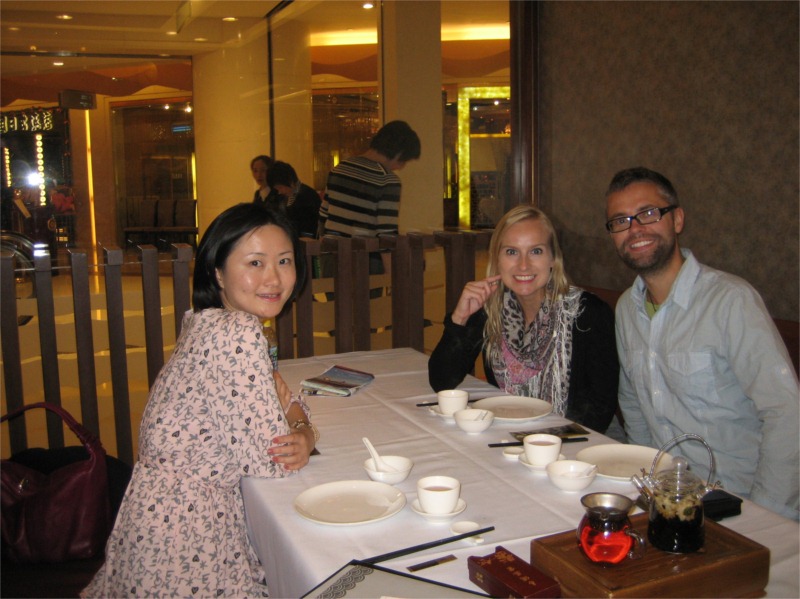
In the MBA I had two Chinese classmates – you have already met Yong but Amanda lives in Shanghai.  Amanda met us at our hostel after we arrived and took us to lunch for some Hong Kong style food. 

We had deep fried rice cubes that tasted a bit like french fries, pork and shrimp dumplings, stir-fried veal, fish and meat balls, chicken feet and cake for dessert.  Everything was really good, especially the dumplings, the deep fried rice and the dessert cake.  The chicken feet were a bit weird but a lot better than we though.  It seems like China continues to surprise us with some fantastic food!

After lunch Amanda took us to town and showed us around, gave us tips on where to shop and where to go for the main attractions before she had to dash off for her best friend’s wedding.  We continued to stroll around the city and enjoy the sights.

Initially we had planned on staying for three nights in Shanghai but we’re considering adding another night before exploring the neighboring cities of Nanjing and Hangzhou.  Shanghai seems such a nice city to just stroll around, enjoy the food, sip tea and watch the people pass by.


Of tombs and barbecues

16 04 2010

Yesterday we went to another tomb close to Xi’an – the tomb of emperor Jingdi who ruled in 188 BC–141 BC.  This tomb was discovered by highway construction crew in 1990. 

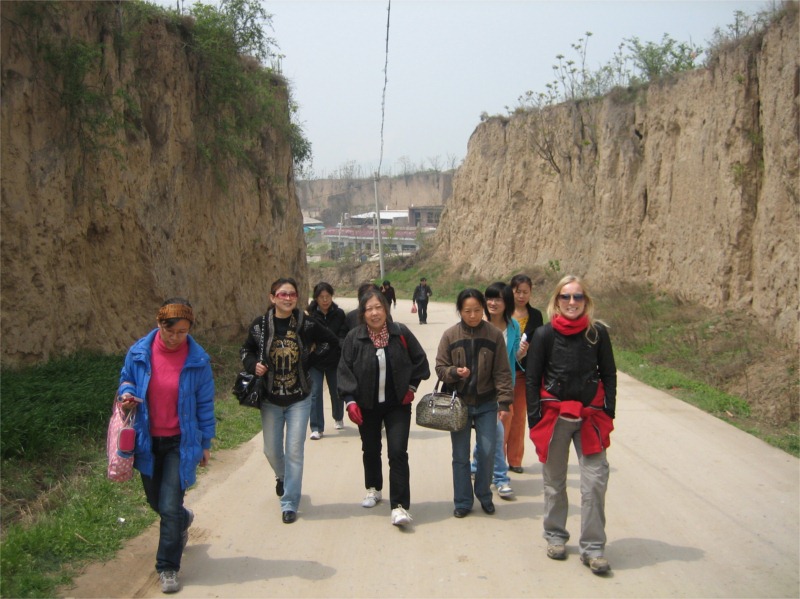
We had to take two busses to get to the tomb but on the first one we were told that the second bus wouldn’t go until thee hours later.  Fortunately we were rescued by five local ladies (one spoke English) that were also going to the tomb.  With them we took a local bus to the middle of nowhere and walked for 25 minutes until we found the tomb.  The ladies were great fun, always laughing and joking around – and really helpful and took care of us in the museum and took us back to Xi’an after the visit.  The Chinese people seem really cheerful and very helpful – even though the language is often an obstacle.

While emperor Qin was said to have ruled with an iron first, emperor Jingdi was a just and fair and ruled according with Taoist believes of going with the flow – he seems like he had a lot in common with the laissez-faire capitalists that have been ruling the western world for the last 10-15 years.  He lowered taxes, used diplomacy rather than force and shrunk the state – and the people prospered.

The tomb was similar to the terracotta army in some ways, it contains many terracotta figures but most of them are quite small – the men about two feet high (Maybe the emperor thought he might spend the afterlife in Lilliput) and not so much army focused, more just items from regular life.  The museum facilities are cleverly constructed and you can get very close to some of the artifacts.  There are glass tunnels above and at the side of the excavation pits where you get a good view everything.

The highlight for me was a holographic 3-D movie telling the story of the emperor and his wife – or so we think.  The movie was only available in Chinese :)  I hadn’t seen such a holographic movie before and was fascinated with the technology.  The movie was shown in a small room and the stage and the figures were quite small, about a foot high.  It was amazing how the figures and the props interacted with the real stage.  Elínborg was less impressed but I was just fascinated.  Just imagine the possibilities for theatre and live performances.  We could be watching plays with the best actors in the world “live” but at a fraction of the current cost.  I think that the 3-D phase that cinema is going through now will be short lived and holograms will take over – or maybe these technologies can work together?

After we returned to Xi’an Yong and Mr. Lee took us for dinner and a few beers.  He took us to a special Xi’an barbecue place that served meat, bread and vegetables.  It seemed like everything (meat, bread and vegetables) was put on skewers and fried and then coated with a spicy herbal seasoning and barbecued.  We had some beef, mutton, bread and bread balls with vegetables and like when we had the hotpot, everything was extremely good.  Yong told us that Xi’an is famous for its noodles and ordered one portion of noodles for us to try.  The noodles were wheat noodles hand made in the restaurant boiled and then covered with some hot oil and chilies and tasted great as everything that Yong has offered us – surely the best noodles that we have had.

It is strange that we have been struggling to find good places to eat in but when we are taken out by locals we have these wonderful meals.  There seems to be a some sort of disconnect here.  I have heard the same stories from people visiting China that the food is a problem but then fantastic meals are just waiting around the corner.

Now we are just preparing for the 16 hours train ride to Shanghai where we will arrive around noon tomorrow.  Yong has told us how nice Shanghai is and we are really looking forward to seeing for our selves.