Western impressions from South-East Asia

20 04 2010

Below is an article that I wrote for a friend’s blog.  You can check out Natasha’s blog here and a permanent link to my article here.  I was very amused reading Natasha’s introduction that I included at the end of the article.

———————————

The first thing that I noticed upon arriving in South-East Asia was the entrepreneurial spirit of the people—a spirit that was noticeable everywhere we went. It might be the case that a lot of the people have been forced to start their own business out of lack of options, but that certainly does not apply to all of them. I started thinking about all the people I know who dream of starting their own business. Do we need to be forced to live the lives we dream of? Being your own boss, though, is not just fun and play, since there is often no one to take care of business for you—and this leads to the next topic: work-life balance

People in South-East Asia seem to work from very early in the morning to very late in the evening, often over sixteen hours a day, and work seems to be their life. If you work sixteen hours and have kids, you have a problem. That problem seems to be fixed in two ways: either people take their kids to work or they depend on their extended family. As you know, the elders in Asia are not put in old people’s homes, but live with their families and have their role there. I’m not saying it should be like this in the West—it’s just nice to see how that works well in Asia.

There is one thing that has bothered me for a long time and that is the feature creep. All too often in the past I wanted to buy something that I had previously been very satisfied with, like the computer that I bought two years ago or the Nokia 5110 phone or a bike with just five gears. Those things should be available at a fairly low price but no, you can only buy the latest model with all the new features that have been invented since. In Asia this is actually possible! It is possible to buy a phone that only does SMS and phone calls, or a bike with no gears, or a low-cost computer that does what you want it to and nothing more.

You can’t miss the great importance of spirituality in Asia. In three of the four countries I visited, Theravada Buddhism is the main religion and participation is very high. Buddhism is quite different from the Abrahamic religions and it seems like spirituality is intertwined with every aspect of people’s lives. In the West there has been more focus on organized religions than on individual and private involvement.

During my travels I also noted at least three issues that are connected with the development of the countries of South-East Asia and their quest to be among the developed nations of this world. I have a lot of questions around those topics but haven’t had the time to find the answers. Maybe you have some insights?

First, how will Asia deal with all the pollution and garbage in the coming years, as they develop? As we consume more resources we create more waste—unless something changes in the way we act. Both garbage and pollution are already a problem in the region, so it is imperative that these countries find new solutions to deal with the waste they create.

Second, how can Asia sustain its agriculture, as the food consumption moves away from rice production towards greater use of meat and grains? When nations become richer they consume more meat and grains than before, which puts more pressure on local resources and on the environment. This will become a big problem in regions that are already under much pressure.

And third, how will Asia deal with even more traffic, with the increase of cars on the roads? When people have more money to spend, more and more of them choose to opt for a car instead of the more traditional scooter. This will put pressure on the already congested traffic system. As I said, I don’t have the answers to these questions, but they kept popping up as we traveled though the region.

—–

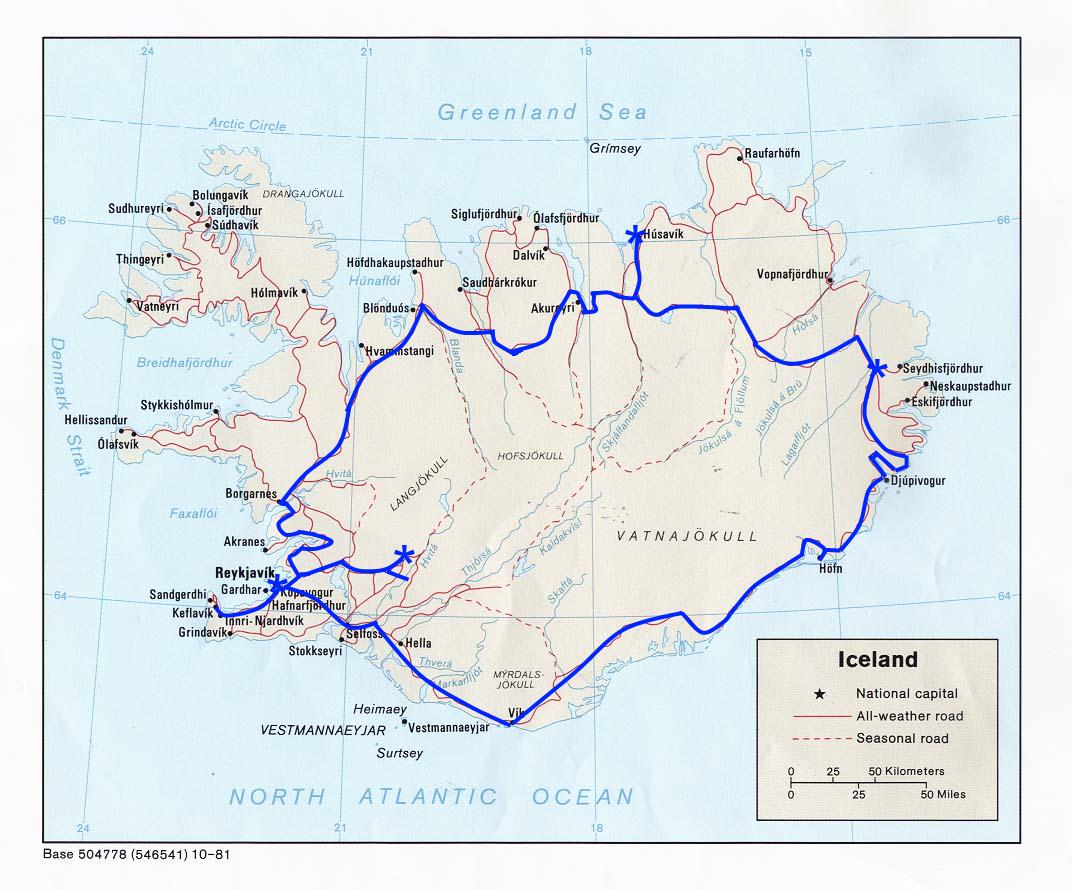
Örn Thordarson was born in Húsavík, on the northern tip of Iceland—the most beautiful place on Earth and home of the Icelandic Phallological Museum. He has a background in computer science and worked in the financial sector for about ten years before getting his MBA from the University of St. Gallen, where he is known for introducing fellow students to fermented shark and sheep’s balls (in addition to numerous other qualities). He is currently travelling in China and plans on returning to Iceland in May 2010.


The trip’s income statement so far (losses and gains)

4 04 2010

Now that we are about to leave South East Asia for China I started thinking about what we have gained – and lost – during the trip.  It is difficult to pinpoint exactly since most of the gains are memories and experience and other internal stuff but I gave it my best shot.

Gained:

  • Like any tourist we have bought a few souvenirs, not too many since we have had to carry them, but a few – and a few presents as well.
  • So far we have gained over 1,300 photos and videos that we didn’t have before.  I’m especially excited about the videos that I plan to edit and post here when back home.
  • We have gained a few items of tailor made clothes.  Suits and shirts and dresses that we hope that will still fit us when we get back.
  • Surely the biggest item that we have gained is experience and the peta bites of memories that we are storing from the trip.  Traveling on our own for three months has been a great experience and hopefully we have matured a bit – wishful thinking but one can always hope :)
  • It is invaluable that we now have more appreciation for the things that we have back home.  Both seeing so many that are not as privileged as us and also just being away from everything that we have have taken for granted has definitely given more appreciation of everything we have back home in Iceland.

Lost

  • We have lost combine 11 kg of body weight.  Without really trying the weight seems to fall off.  I credit this mostly to proper portion sizes since we are eating all food – fried, baked, roasted, candy, ice-cream and everything else.
  • Surely we have lost (or rather invested) a few thousand dollars.  I would say though that the trip hasn’t really been expensive and definitely well worth it.  Maybe we’ll calculate the real cost when we get back home and post it here on the blog.
  • In the annoying bus incident I lost a wallet, gaffer tape, a flash light and one thousand krónur so that must be accounted for.
  • After the bed bugs attack Elínborg threw away her sleeping bag so that one is definitely lost.  She also washed her purse and then left it outside in the sun to dry and someone took it by mistake so the purse can be written on the bed bugs as well.
  • We were quite happy to loose the white/gray skin color that we brought with us.  It has, at least momentarily, been replaced by darker/browner color.  I hope that we can bring some of that color back home but we’ll have to see what China has to say about that.

So if we balance the books I think that we have gained a lot more than the few items that were lost and most of them we were quite happy to get rid of (grayish skin and fat).

Tomorrow we’ll be flying to Hong Kong for a couple of days and then it’s China baby!

Happy Easter everyone!


How would YOU catch squid?

3 04 2010

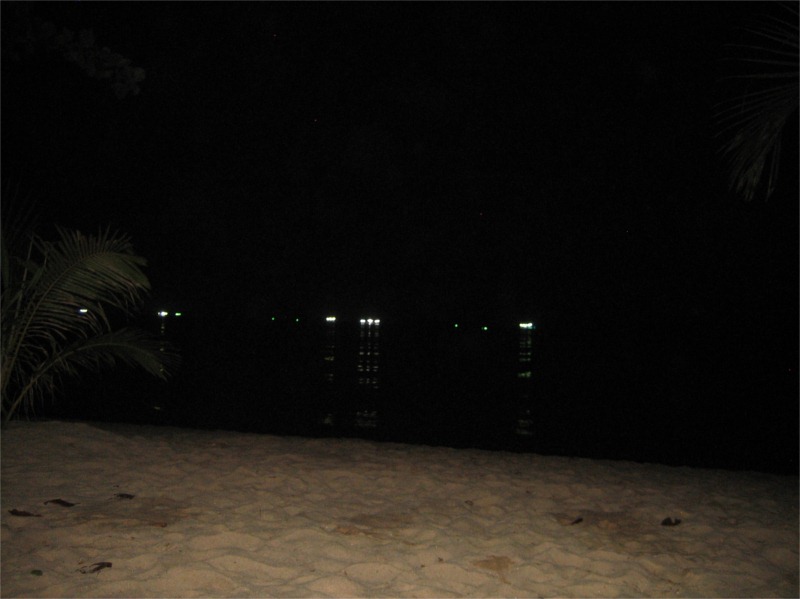
While on Ko Phangan it is difficult not to notice all the fishing boats that are catching squid around the island at night.  First we just saw the lights out at see and started wondering what those would be and as we found out they were squid fishing boats.

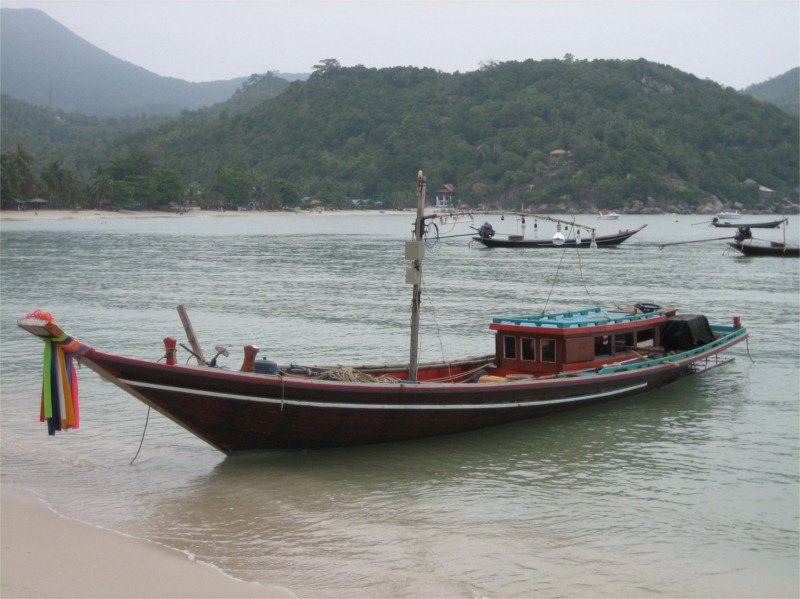
Most of the boats are fairly big with a couple of poles with big lights attached to them that can stretch out to either side of the boat.  The boat on the picture below only has one small light pole.  The smallest boats look like circular tee filters with a diameter of maybe 1.5 meters and are made of bamboo but the majority are 10-15 meters sturdy wooden boats

The boats all stay close to the shore during the day but as the sun is setting they start moving to the proper spots.  It seems like most of them like to fish about five hundred meters from the shore and quite close to each other.  After the sun has set they extend their light poles and turn on their huge lights.  From the porch of our favorite restaurant on Ao Mae Haad we could see about ten boats all lined up glowing in the dark.  The lights are to lure the squid to the surface where it is easy to catch.

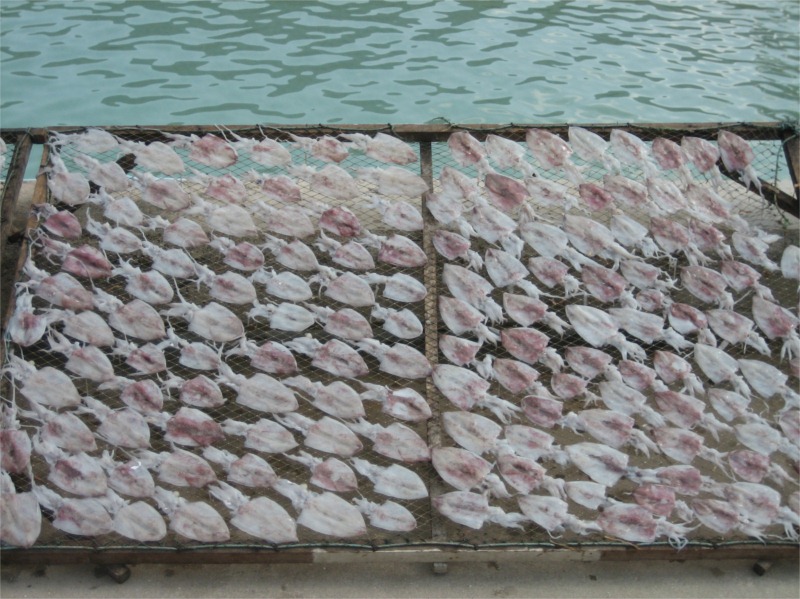
There is a lot of squid available in Thailand both dried and fresh.  A lot of street vendors are selling dried squid in the streets.  We never tried it but I’m sure it is similar to the dried cod or haddock that we eat back home.

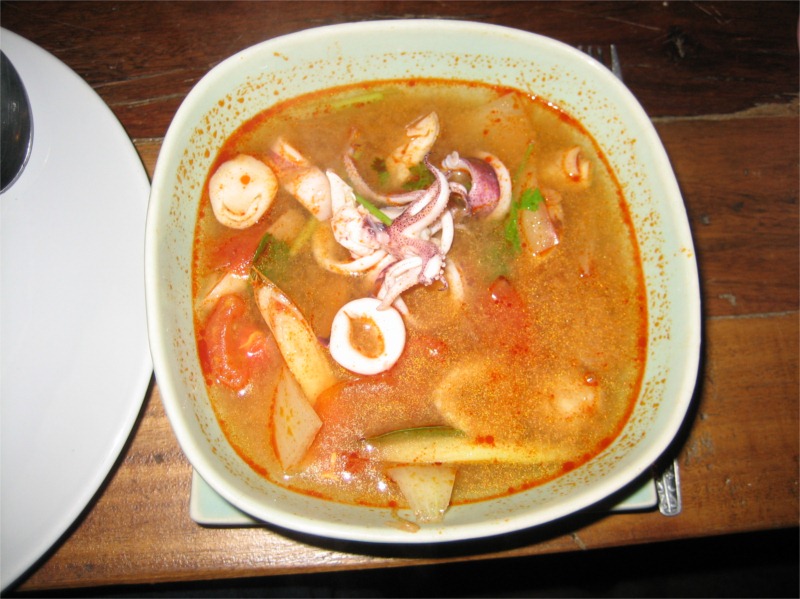
We have however had the fresh squid on numerous occasions and it has never disappointed.  It has been great with fried rice, fantastic fried but like the squid best in a hot Tom Yum soup …I just start drooling when thinking about it.


Robbed on the bus from Bangkok!

31 03 2010

Last time we met, we were on our way from Chang Mai in Northern Thailand and all the way down to Ao Mae Haad on Ko Phangan in Southern Thailand.  In 48 hours we spent 30 on a bus and two in a boat but it was all worth it when we came to Mae Haad.  This is not the first time we’ve been here, we came here near the beginning of our trip as can be seen in previous posts: Island hopping, Little piece of heaven and From one island to the next.

The journey wasn’t without its incidents as we discovered when we arrived in Mae Haad.  When we opened our bags it was obvious that someone had gone through the bags in search for something.  After a closer inspection we were only missing a flashlight, a watch, a wallet with 1,000 ISK and one roll of gaffer tape.  Since the Icelandic króna is practically worthless these days it wasn’t such a big loss :) maybe the biggest loss was in my watch but I’m sure I’ll make up for that in China!

We have been warned on several occasions not to leave any valuables in our big back pack and fortunately we have our ears open once in a while.  We had all our valuables with us – it was unlucky that the watch was there but I had bought a nice fake watch in Chang Mai.  Of course I won’t tell anyone which kind because I want you to think that I have the real thing ;)

The life for the past five days here in Mae Haad has been wonderfully simple.  We wake up around nine and go to the beach – eat lunch when we get hungry and then head for the beach again until about sunset – then its time to clean up before dinner – eat dinner and go to sleep.  The beach here is beautiful and great snorkeling.  There is plenty of people during the day but most come here by bike and go back before dinner so the evenings are quiet.

Once a month there is a big Full Moon party here on Ko Phangan with up to 30,000 visitors.  On the day of the Full Moon Party we rented a motor bike and drove around the island.  We tried to drive to Bottle Beach, supposedly one of the most beautiful beaches around, but the road was so horrible that we turned around when we could almost see the beach.  There is possible to get there by boat so we might try that before we leave.  After Bottle Beach we went to Haad Rin where the party takes place.  We thought that we would be able to catch the beginning of the party before heading home but it started very slowly unlike an Icelandic “Verslunarmannahelgi” and we kind of missed it :(  The roads here are not that great that we wanted to be driving in the dark on the busiest night of the month. 


Is backpacking in Asia something for you?

30 03 2010

It is only natural that before going on an almost four month journey with just a single back pack, something that we hadn’t done before, we had some concerns and worries regarding how things will turn out.  In this post I will list the main concerns we had before leaving home and address them now that we have visited all the four countries, here in South East Asia, that we will be visiting on this trip.  So below are our concerns.

Is backpacking something for us?
Will it be fun to travel for four months?
How will the accommodation be at our price point?
Will we like the food?
What about sanitation and what diseases could we catch?
What about visas?
What about bugs and other unknown creatures?
Will there be people everywhere trying to scam us?
Will we be in danger?

Is backpacking something for us?

We have seen people from the age of seventeen up to almost seventy backpacking so it is fair to say that backpacking can be for anyone – at least age doesn’t seem to be a deciding factor.

Being on our own with nothing other than our backpack has given us great freedom to go wherever we have wanted to go, whenever we have wanted to go.  We have had absolute freedom regarding how we spend our money and when.  All that freedom has been just fantastic. 

We have been on an organized trip before and I have to say that backpacking suites us much better than a package trip, especially here in South East Asia where there are so many people backpacking and the infrastructure for it is great.  It is less of a hassle than one would think and it quickly becomes a routine to find a new hostel or organize activities or decide where to go next.

Will it be fun to travel for four months?

Before heading off this was a big question mark.  Before this trip our longest trip had been three weeks or so and we have always been quite happy to return home. 

Travelling for such a long time has definitely been different in many ways.  We have not been in such a rush to see as much as we can before returning home and that has given the whole trip a different rhythm.  It has also affected our buying habits in a nice way – often when abroad we’ve been thinking about what to buy and maybe focusing too much on that aspect but now we have just postponed all buying decisions and just been enjoying the places we have been visiting.

Of course there have been ups and downs in the almost three months that have already passed but for the most part the trip has been a fantastic adventure.  I think that the downs are mostly connected with staying too long in a particular place and we have become bored of the place or maybe more the atmosphere at that place.  A couple of times we have also experienced a kind of travel boredom where for instance we can go and see a world famous temple or something like that but because we have seen so many fantastic temples we aren’t really interested, which is kind of sad.

I’m not sure we’ll ever go on such a long trip again and this has surely been a once in a lifetime experience.  I think that the optimal trip length for us might be somewhere around six to eight weeks and we would surely rather go twice for eight weeks than once for the four months :)

There are numerous stories of people that start backpacking and when the get back home the can’t wait to go on the road again …and again so only time can tell how thing will go in our case :)

How will the accommodation be at our price point?

We have been staying at budget hostels and guesthouses, typically priced between 8-20 dollars for two depending on the price level in that particular town.  I would say that the accommodation in general has been better than we expected.  Of course there have been a few instances where we should have looked further but decided to stay but for the most part we have been fairly lucky.  The worst experiences have been when we have arrived after dark to a new place tired and annoyed and not bothered to look hard enough and settled for something less than satisfying – we’ve kind of always known but still didn’t look further.

Will we like the food?

The food around here has ranged from being absolutely fantastic to being nothing special.  It has never been bad and that says something.  We only had problems finding something we liked on two occasions, first in Bangkok after we arrived and that was just that we were afraid to try and too conscious about sanitation and cleanliness, which has never been an actual problem here.  The other time was in Phenom Penh where it wasn’t easy to find nice places to eat at.

In general the Western food hasn’t been too good except that we’ve had a few good pizzas.  The Western food is also a lot more expensive than the local food and definitely not worth the extra money.  In quite many places we could find Indian food and that was always very good.  A bit more pricy than the local food but great to mix things up.

The Thai food has been fantastic wherever we have been – at the guesthouses, with street vendors or at restaurants.  The curries and the fried rice, soups and nonames, noodles and pancakes and the variety of fresh seafood is astonishing.

The food in Cambodia was a bit of a disappointment after the Thai food.  It always felt like they put too little chilly in everything so it tasted a little bland.  The exception was the Amok, which is a special kind of Cambodian curry.  The food wasn’t bad but just needed more seasoning for our taste.

Vietnamese food received mixed reviews in the group.  I loved the food but Elínborg was less impressed.  They have a great variety so there is plenty to choose from and everyone should be able of find something they like.  The street vendors offer really fresh and good baguettes that we ate a lot for breakfast and most places have wonderful Vietnamese coffee.

The food in Laos was always good – even the Western food.  It had some French influence with great baguettes and fantastic Lao coffee and I only remember everything tasting good in Laos.

What about sanitation and what diseases could we catch?

In terms of diseases we took some precautions before heading off.  We went to a vaccination clinic in Switzerland and got all the vaccinations they recommended.    Of course one can not be vaccinated against all diseases so we took some medicine with us.  What we took is listed here.

We have actually been surprised about the sanitation level of food and food products. We just expected that we would have a mild food poisoning once in a while or stomach aches after eating something bad but that hasn’t occurred at all.  We have had some aches after eating something too spicy for our stomachs but that is easy to avoid.  We have eaten at Western restaurants, local restaurants, local homes, street vendors and food markets and at no point have we eaten anything that has given us problems.

What about visas?

When you fly into Thailand you get a 30 day visa exemption for free (at least most European citizens) and if you enter on land borders you get a 15 day exemption so there is no hassle to enter Thailand, just make sure that you don’t overstay the exemption or you’ll get a 500 baht per day fine.

Visa into Cambodia is available at most borders for $20.  We had heard of Cambodian border controllers asking for more money and to avoid all hassle we bought an e-Visa off the internet for $25, a very easy two day process and in the end you have a print-out that you show at the border.

We got the Vietnamese visa in the Vietnamese embassy in Bangkok.  I think that it cost 1,900 baht if you wait for two days but 2,200 baht, just over $60, if you want to pick it up the next day.  However it was much cheaper to get the visa at the Vietnamese embassy in Phenom Penh, Cambodia.  I think that it costs 30-35 dollars over there.

The Visa into Laos was available at the airport in Luang Prabang and cost about $30.  We were out of dollars but they were happy to take baht instead – at a reasonable exchange rate.

When we entered Burma we got a day permit (apparently good for two nights) at the border for $10 or 500 baht so bring dollars if you have them.

The visa for China we got at the Chinese embassy in Reykjavík.  We got a six month visa with two entries just to make sure and that was around $100 if I .remember correctly.  Maybe a three month, one entry visa would have been sufficient but we didn’t really know at the time.

So if you stay slightly informed the visas shouldn’t pose any problems.  Just check before the trip if all the countries that you want to go to offer visas to citizens of your country.

What about bugs and other unknown creatures?

The only creature that has really been bothering us are the mosquitoes.  They seem to love fresh Nordic blood.  There are over 3,000 different types of mosquitoes, each slightly different from the others.  We have usually been most bitten when we are at a new place.  Then we learn how, where and when the mosquitoes bite and can better avoid them.  Some bite in the morning, others at dusk and yet others during the night.  Some bite mostly by the joints, others on the feet and some in the limbs so the are a bit difficult to figure out.  The best way to avoid them is to be properly clothed in the early morning and at dusk and apply some mosquitoes repellant – we have used 50% deet.

We have once meet bed bugs.  We didn’t see them at first, actually we weren’t really looking but as soon as we laid on the bed the came forwards.  Bed bugs are nasty looking creatures looking a bit like lice and they bite you if they can.  The bite is not dangerous but itches a lot.  We had been warned that we could encounter them and that we should always check the beds before deciding on a room but we hadn’t seen any after ten weeks so we weren’t really checking any more.

We have seen some rats but only in the street so they have not been bothering us at all.  We have seen some cockroaches as well and had a few of them visiting our rooms but I wouldn’t say that has been common – maybe in every tenth guesthouse or even more seldom.  There are ants everywhere here so if you leave something they like they are pretty quick to find it and carry it away so don’t forget those chips on the table :)

Will there be people everywhere trying to scam us?

We have encountered a few scams along the way as can be seen here.  I think that all of them can be easily avoided by using common sense and be a little prepared.  The Lonely planet books list a few of the scams so that is a good start.  Just remember that there is no free lunch and always double check all prices and you’ll be good

It is understandable that people with little money try get as much for products and services as they possibly can – it’s the same as we do in the West – so that can’t really be categorized as a scam.  We have however seen that it pays to shop around and check for the prices at other vendors.  Often people add a tourist premium or just think that you have just arrived and try to charge too much.

Will we be in danger?

I don’t think that we have been in any danger at any point in our trip, at least not more danger than if we would have stayed at home ;)  Everyone connected with tourism has seemed to us as very responsible and safety minded.  Even the bus drivers, that seem to have a bad reputation on the internet, were quite good and drove responsibly.

Just one warning, always keep all valuables with you and not in your big back pack, especially while on the busses.  At one point someone went through our bags during a bus ride and we have heard of other instances on boats and in storage rooms at guesthouses so it is better to be safe than sorry and keep everything valuable with you!

Lonely Planet – Southeast Asia on a Shoestring Travel Guide

28 03 2010

southeast-asia Before going on our trip we bought the latest Lonely Planet – Southeast Asia on a Shoestring Travel Guide (14th Ed.), published in March 2008.  The book contains separate chapters on each of the countries in South East Asia and for each country it lists the main cities, towns and other notable places.  For each of those places place it in turn lists the main activities, main sights, accommodation options and eateries and lists the prices for everything above.

We thought we would be all set with this book as it covered all the four countries that we planned to visit and we were not alone with that thought.  A great majority of the people we have seen on the road have been carrying this same book. 

I can only say for us that we were greatly disappointed.  We weren’t satisfied with this book at all!  It focuses mainly on accommodation and where to eat but less on what is really interesting in the places it recommends so it hardly passes as a travel guide – its more of a hostel/guesthouse/restaurant directory.  If the book would have been a good hostel/guesthouse/restaurant directory we wouldn’t have any complaints but it wasn’t at all.  The info it gave was too out-dated for that, the prices were way wrong and the descriptions were often inaccurate.  Maybe we should have known better, buying a book that was one and a half year old at the time but it was the latest version and we didn’t give it a second thought.

Before the trip I had read a lot of reviews that complained about Lonely Planet and this book might be the reason.  If we were repeating the same trip we would not buy this book.  We probably wouldn’t even take it if it would be given to us!  Therefore we really can’t recommend this book for anyone unless they have a brand new version. 

We however bought the Lonely Planet – Vietnam book while in Cambodia and that one was very good.  It had good descriptions on every place we visited with a lot more info than the shoestring book and the info was very accurate and thorough.

If we would have known then what we know now we would have bought the Lonely Planet – Thailand book before leaving home – so that we could plan the first couple of weeks.  For the ten days we spent in Cambodia we didn’t really need a guide book and we really liked the Vietnam book we bought in Cambodia so I guess we would buy that one again – or the Rough Guide – Vietnam. 

By the way, they sell a lot of really cheap copies in Cambodia (we saw them in Vietnam as well) so keep that in mind.  The copies are of decent quality but the maps, pictures and drawings are nothing special.  What is good about them is the price, a Lonely Planet book that costs around $20 on Amazon is available for just $3-4 in Cambodia.  With that kind of an investment it is easy just to leave the book behind when you don’t need it anymore.  Of course the downside is that they are illegal so you wouldn’t be buying those books, would you?

For the ten days we spent in Laos we didn’t really need a book but we would have liked to travel more in Laos and then we would surely need a guide book and I guess that the Lonely Planet – Laos is as good as any but just to get the comparison it might be a good idea to get the Rough Guide – Laos for cheap in Vietnam before entering Laos.

For the China part of our trip we have purchased Lonely Planet – China and it looks good but the real judgment will be handed out after we have used it in China.