Western impressions from South-East Asia

20 04 2010

Below is an article that I wrote for a friend’s blog.  You can check out Natasha’s blog here and a permanent link to my article here.  I was very amused reading Natasha’s introduction that I included at the end of the article.

———————————

The first thing that I noticed upon arriving in South-East Asia was the entrepreneurial spirit of the people—a spirit that was noticeable everywhere we went. It might be the case that a lot of the people have been forced to start their own business out of lack of options, but that certainly does not apply to all of them. I started thinking about all the people I know who dream of starting their own business. Do we need to be forced to live the lives we dream of? Being your own boss, though, is not just fun and play, since there is often no one to take care of business for you—and this leads to the next topic: work-life balance

People in South-East Asia seem to work from very early in the morning to very late in the evening, often over sixteen hours a day, and work seems to be their life. If you work sixteen hours and have kids, you have a problem. That problem seems to be fixed in two ways: either people take their kids to work or they depend on their extended family. As you know, the elders in Asia are not put in old people’s homes, but live with their families and have their role there. I’m not saying it should be like this in the West—it’s just nice to see how that works well in Asia.

There is one thing that has bothered me for a long time and that is the feature creep. All too often in the past I wanted to buy something that I had previously been very satisfied with, like the computer that I bought two years ago or the Nokia 5110 phone or a bike with just five gears. Those things should be available at a fairly low price but no, you can only buy the latest model with all the new features that have been invented since. In Asia this is actually possible! It is possible to buy a phone that only does SMS and phone calls, or a bike with no gears, or a low-cost computer that does what you want it to and nothing more.

You can’t miss the great importance of spirituality in Asia. In three of the four countries I visited, Theravada Buddhism is the main religion and participation is very high. Buddhism is quite different from the Abrahamic religions and it seems like spirituality is intertwined with every aspect of people’s lives. In the West there has been more focus on organized religions than on individual and private involvement.

During my travels I also noted at least three issues that are connected with the development of the countries of South-East Asia and their quest to be among the developed nations of this world. I have a lot of questions around those topics but haven’t had the time to find the answers. Maybe you have some insights?

First, how will Asia deal with all the pollution and garbage in the coming years, as they develop? As we consume more resources we create more waste—unless something changes in the way we act. Both garbage and pollution are already a problem in the region, so it is imperative that these countries find new solutions to deal with the waste they create.

Second, how can Asia sustain its agriculture, as the food consumption moves away from rice production towards greater use of meat and grains? When nations become richer they consume more meat and grains than before, which puts more pressure on local resources and on the environment. This will become a big problem in regions that are already under much pressure.

And third, how will Asia deal with even more traffic, with the increase of cars on the roads? When people have more money to spend, more and more of them choose to opt for a car instead of the more traditional scooter. This will put pressure on the already congested traffic system. As I said, I don’t have the answers to these questions, but they kept popping up as we traveled though the region.

—–

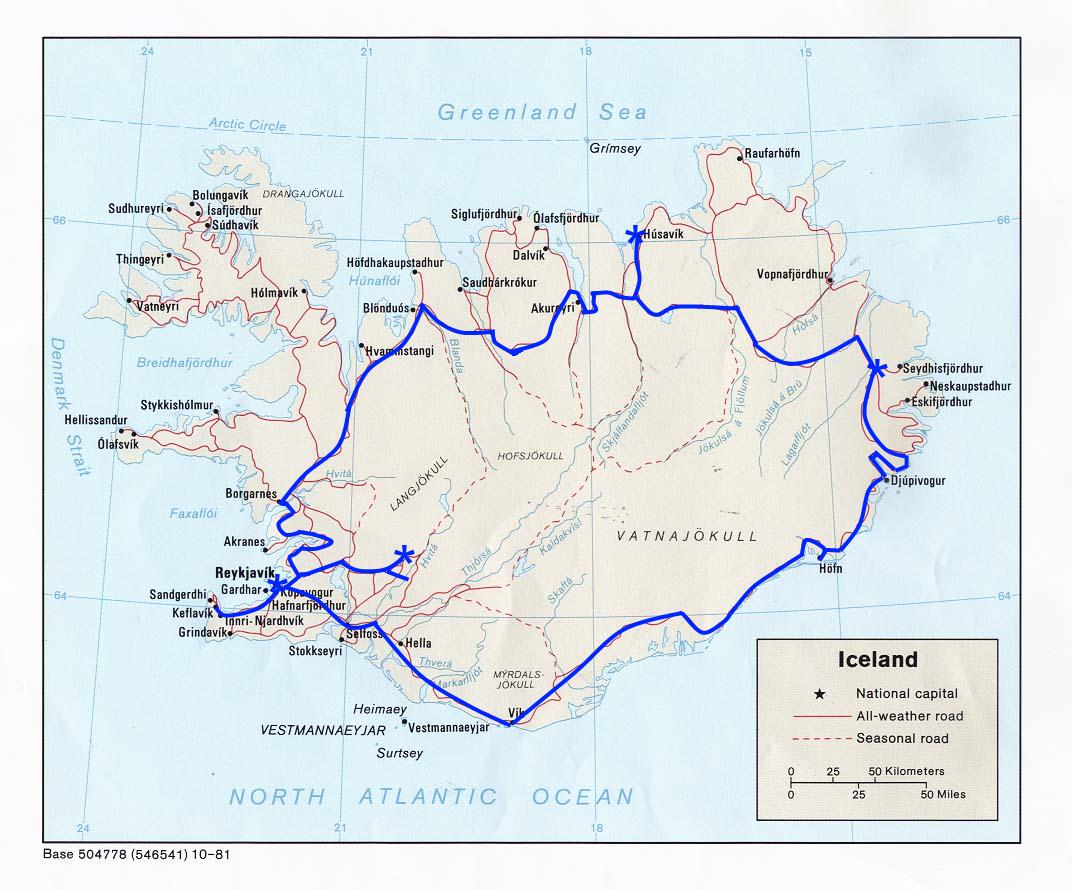
Örn Thordarson was born in Húsavík, on the northern tip of Iceland—the most beautiful place on Earth and home of the Icelandic Phallological Museum. He has a background in computer science and worked in the financial sector for about ten years before getting his MBA from the University of St. Gallen, where he is known for introducing fellow students to fermented shark and sheep’s balls (in addition to numerous other qualities). He is currently travelling in China and plans on returning to Iceland in May 2010.


Not Shanghaied yet

18 04 2010

Shanghai is China’s largest city and and the largest city proper in the world with a population of over twenty million.  We’ve been in Shanghai now for two days and the difference from Beijing and Xi’an is obvious.  The city is ultra modern, international and slick with huge skyscrapers towering the streets everywhere you look.  The city feels a lot brighter than Beijing and has less air pollution and somehow has a better all-around wibe to it.

Coming to Shanghai has been a great relive in two ways.  First, there are signs in English almost everywhere and a lot of people speak English so the language barrier is a lot lower than elsewhere.  Secondly, it doesn’t take a local to find good food here in Shanghai :)  There seems to be good restaurants everywhere you look so the problem of finding something decent to eat turns into the luxury problem of choosing what to eat: Chinese-, western- or Japanese food.

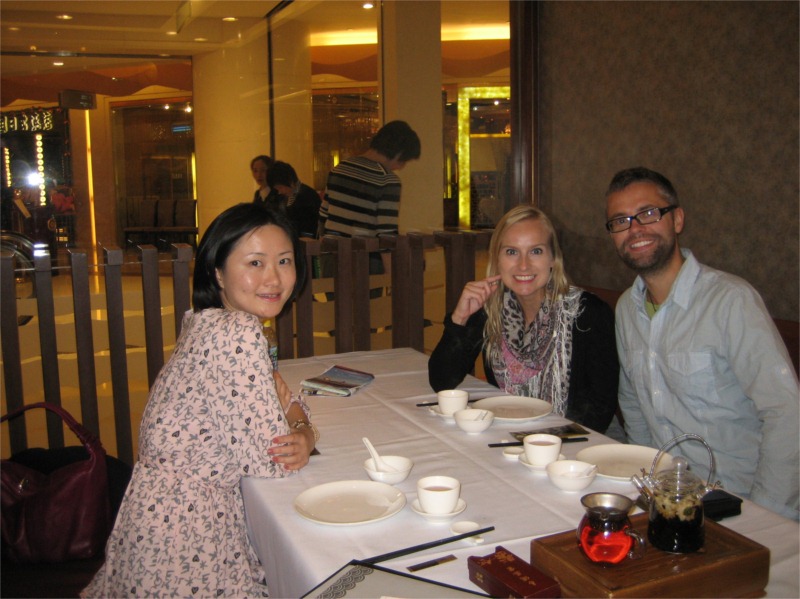
In the MBA I had two Chinese classmates – you have already met Yong but Amanda lives in Shanghai.  Amanda met us at our hostel after we arrived and took us to lunch for some Hong Kong style food. 

We had deep fried rice cubes that tasted a bit like french fries, pork and shrimp dumplings, stir-fried veal, fish and meat balls, chicken feet and cake for dessert.  Everything was really good, especially the dumplings, the deep fried rice and the dessert cake.  The chicken feet were a bit weird but a lot better than we though.  It seems like China continues to surprise us with some fantastic food!

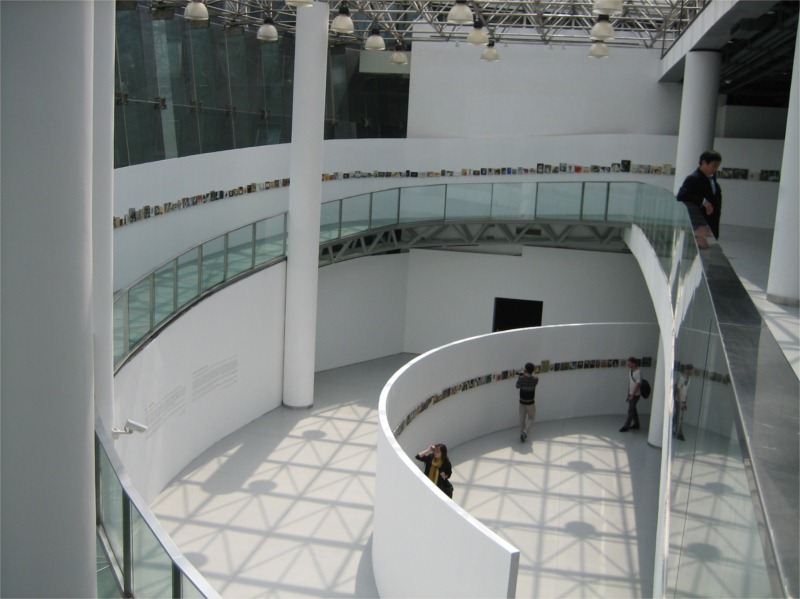
After lunch Amanda took us to town and showed us around, gave us tips on where to shop and where to go for the main attractions before she had to dash off for her best friend’s wedding.  We continued to stroll around the city and enjoy the sights.

Initially we had planned on staying for three nights in Shanghai but we’re considering adding another night before exploring the neighboring cities of Nanjing and Hangzhou.  Shanghai seems such a nice city to just stroll around, enjoy the food, sip tea and watch the people pass by.


Of tombs and barbecues

16 04 2010

Yesterday we went to another tomb close to Xi’an – the tomb of emperor Jingdi who ruled in 188 BC–141 BC.  This tomb was discovered by highway construction crew in 1990. 

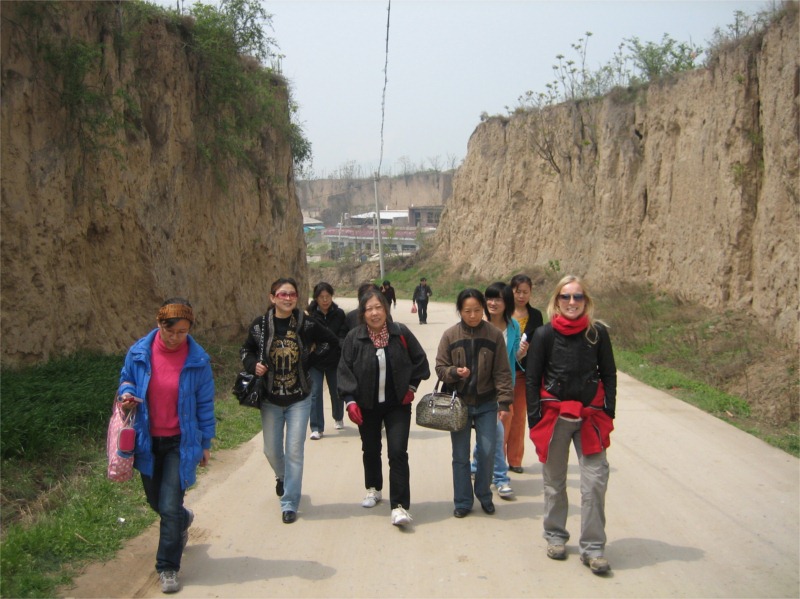
We had to take two busses to get to the tomb but on the first one we were told that the second bus wouldn’t go until thee hours later.  Fortunately we were rescued by five local ladies (one spoke English) that were also going to the tomb.  With them we took a local bus to the middle of nowhere and walked for 25 minutes until we found the tomb.  The ladies were great fun, always laughing and joking around – and really helpful and took care of us in the museum and took us back to Xi’an after the visit.  The Chinese people seem really cheerful and very helpful – even though the language is often an obstacle.

While emperor Qin was said to have ruled with an iron first, emperor Jingdi was a just and fair and ruled according with Taoist believes of going with the flow – he seems like he had a lot in common with the laissez-faire capitalists that have been ruling the western world for the last 10-15 years.  He lowered taxes, used diplomacy rather than force and shrunk the state – and the people prospered.

The tomb was similar to the terracotta army in some ways, it contains many terracotta figures but most of them are quite small – the men about two feet high (Maybe the emperor thought he might spend the afterlife in Lilliput) and not so much army focused, more just items from regular life.  The museum facilities are cleverly constructed and you can get very close to some of the artifacts.  There are glass tunnels above and at the side of the excavation pits where you get a good view everything.

The highlight for me was a holographic 3-D movie telling the story of the emperor and his wife – or so we think.  The movie was only available in Chinese :)  I hadn’t seen such a holographic movie before and was fascinated with the technology.  The movie was shown in a small room and the stage and the figures were quite small, about a foot high.  It was amazing how the figures and the props interacted with the real stage.  Elínborg was less impressed but I was just fascinated.  Just imagine the possibilities for theatre and live performances.  We could be watching plays with the best actors in the world “live” but at a fraction of the current cost.  I think that the 3-D phase that cinema is going through now will be short lived and holograms will take over – or maybe these technologies can work together?

After we returned to Xi’an Yong and Mr. Lee took us for dinner and a few beers.  He took us to a special Xi’an barbecue place that served meat, bread and vegetables.  It seemed like everything (meat, bread and vegetables) was put on skewers and fried and then coated with a spicy herbal seasoning and barbecued.  We had some beef, mutton, bread and bread balls with vegetables and like when we had the hotpot, everything was extremely good.  Yong told us that Xi’an is famous for its noodles and ordered one portion of noodles for us to try.  The noodles were wheat noodles hand made in the restaurant boiled and then covered with some hot oil and chilies and tasted great as everything that Yong has offered us – surely the best noodles that we have had.

It is strange that we have been struggling to find good places to eat in but when we are taken out by locals we have these wonderful meals.  There seems to be a some sort of disconnect here.  I have heard the same stories from people visiting China that the food is a problem but then fantastic meals are just waiting around the corner.

Now we are just preparing for the 16 hours train ride to Shanghai where we will arrive around noon tomorrow.  Yong has told us how nice Shanghai is and we are really looking forward to seeing for our selves.


The eighth wonder of the world

15 04 2010

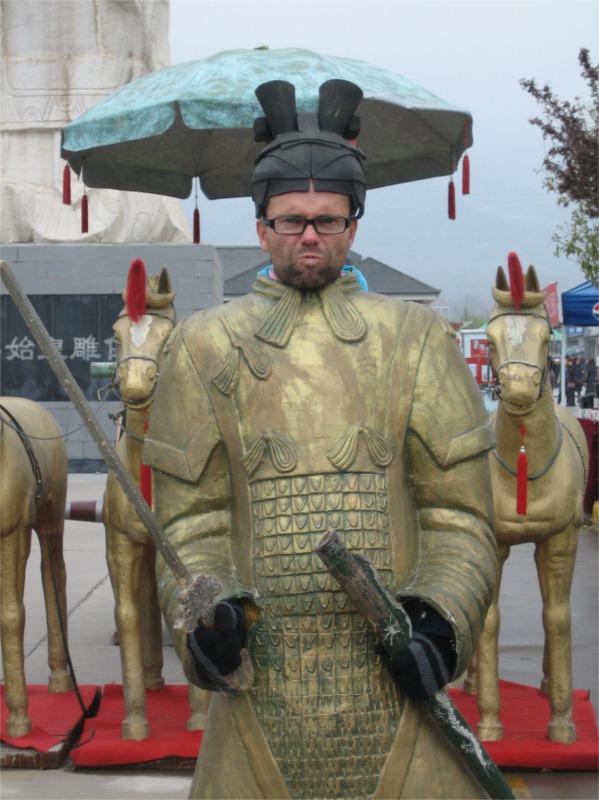
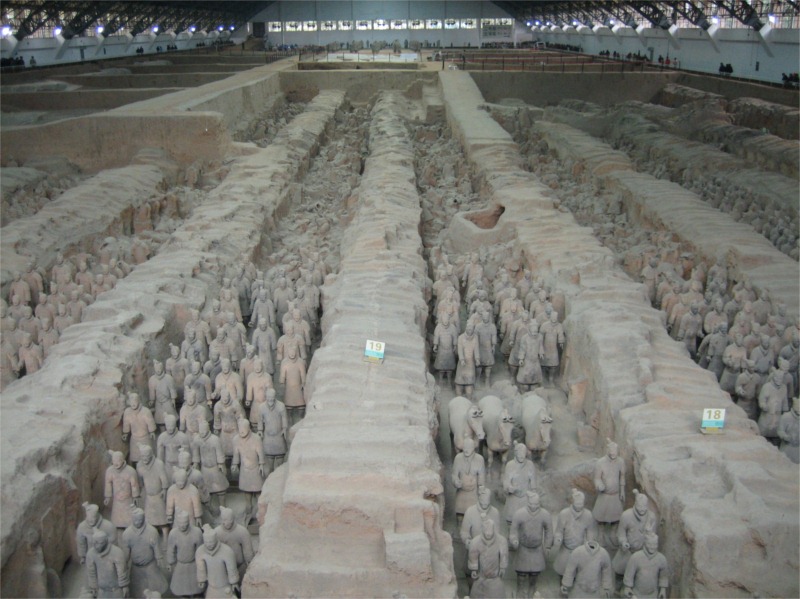
Yesterday we went to see the Terracotta Army.  The Terracotta Army is a whole army, current estimates say 8,000 man strong, constructed by Emperor Qin around the year 200 BC.  Most of the figures are full sized and every figure is unique in shape and facial features. 

The emperor constructed his army to support him in the afterlife.  The emperor didn’t stop there and built a whole city in addition to his army.  There are acrobats and musicians, all kinds of animals, offices and stables and everything that comes with a proper city.

The site was found by a couple of farmers digging for water some thirty years ago and stumbled onto the first pit.  Now three pits have been excavated but some archeologist believe that even more pits wait to be discovered.  I just wonder how many sites like this exist in the world – uncovered and hidden to everyone?

Getting to the site was very easy – just a bus straight from the train station.  There was a constant stream of visitors arriving at the gate, mostly Chinese tourists but also a few foreigners. 

After buying the tickets there is a twenty minute walk to the main sites.  Along the way there are several restaurants including KFC and Subway and a lot of shops selling stuff made from jade, stuff made from fox/wolf/mink skins and terracotta warrior replicas.  The whole place had a very commercial feel to it – in a nice way though.  I couldn’t resist all the sales people and bought a very nice skin hat – similar to the Mao hat I had previously bought ;)

After the walk we arrived at the main gate.  We had only heard the best things about the Terracotta Warriors so at this point we were very excited! 

The site consists of a museum and three excavation pits.  We started at the museum, which contained examples of what was found in the pits as well as explanations on how all the stuff was made, why it was made and by whom.  After the museum we headed for the smallest pit that gave us a taste of what was to come.  The second pit wasn’t that exiting and hasn’t been fully excavated.  The third pit is the main attraction and contains the real Terracotta Army. 

It was very impressive to see all those soldiers lined up like they were ready for battle.  It was also very interesting to see the archeologists still working on digging up more figures.  We were very impressed with the whole site and really happy that we came to see this wonder but I couldn’t resist the thought that maybe it has been hyped up a bit too much.

It is very interesting to see how the Chinese approach archeological discoveries like the Terracotta Army and others that we have seen here in China.  They have a different approach to what we are used to seeing, at least back home.  The Chinese don’t hesitate to rebuild and fix or even recreate artifacts and buildings without distinguishing the from the authentic artifacts.  This makes it sometimes difficult to differentiate between the old and the new or the authentic and the re-created.  At the same time it is of course really interesting to see how things looked like when they were first created and you can better see the whole picture when the blanks have been filled.

This site is a perfect example of how crazy us humans can get.  Why would someone want to build such a mausoleum for him self?  It has been estimated that construction the whole mausoleum involved some 700,000 workers and took several years.  At the same time it shows the power of the emperor and how prosperous his nation must have been being able undertake such a project.  What do you think?  How do you want your mausoleum to look like?


Of Chinese hotpots

14 04 2010

When we arrived in Xi’an we were greeted by my colleague Yong, Yong and I were classmates in the MBA in St. Gallen last year.  Yong lives and works in Xi’an and was at the train station with his colleague Mr. Lee.  Yong and Mr. Lee were kind enough to show us around until we could check in to our hotel at noon.

We saw the fanciest part of town where the government has built a great looking garden to jack up real-estate prices in the surrounding areas.  It is quite obvious that there is no recession in Xi’an, you can see building cranes everywhere and a lot of things going on. 

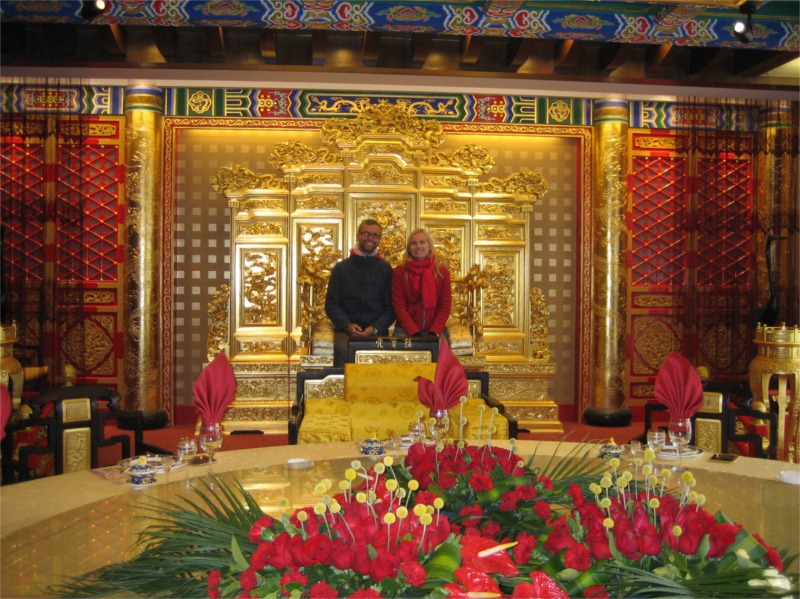
We went to a culture center that acted both as a museum displaying traditional Chinese art – paintings, sculptures and antiques – as well as a restaurant and a meeting place for the rich.  The whole place was fancy to say the least but the fanciest piece in the whole place was a nice piece of pork that had been conserved in some kind of transparent coating.  Very arty!

For lunch Yong and Mr. Lee took us to a Chinese hotpot restaurant.  We had never tasted a Chinese hotpot before so we were very excited.  On the table came two pots, one with some kind of lightly seasoned fish broth and a the other with a spicy kind of chili soup. 

We went to a communal table to create a dipping sauce where we could choose from about twenty different ingredients: garlic, chili,  spring onions, ground peanuts, sesame oil, soya sauce, peanut sauce, fish sauce and many others that I didn’t recognize.  We just followed Yong and tried to do as he did.  In the end our dipping sauces tasted great :)

Finally all sorts of things to dip into the boiling hotpots came to the table: mutton, beef, ground meat, mushrooms, seaweed, noodles, beads, fish balls and cabbage and I’m sure I’m forgetting a few items.  Gradually the dipping things were were dipped into the hotpots to boil and then we ate them.  We can both agree that this was absolutely fantastic and the best Chinese food we have ever tasted.  We had a Japanese hotpot in Bangkok but this was much better, especially the spicy one. 

Thank you very much Yong !!!

After the late lunch we had no choice but to go back to our hotel to digest and relax for the rest of the day.  We watched Resident Evil II on the computer – highly recommended …hehe.


When we woke up in Xi’an

14 04 2010

We spend our last whole day in Beijing strolling round Central Beijing.  We walked to Tiananmen Square where I bought a old fashioned Chinese/Russian winter hat.  We had been stared at before but nothing like when I had the hat on.  Later we were told that the Chinese connect the hat with Chairman Mao and his followers.  We were also approached by several Chinese people that wanted us to pose with them on photos.  We felt like rock stars but somehow this was a strange and surreal experience.

After checking out Tiananmen Square and the surrounding buildings we walked to Jingshan Park.  The park is located on a small hill, 45 m. above the very flat surroundings, just behind the Forbidden City.  There seems to be an (small) entrance fee where ever you go here but and we paid 2 Yuan to get in (15 cent).  The view from the top of the hill was great!  We saw over the Forbidden City and basically all over Central Beijing – or as far as the smog allowed us – and this was something we should have done on day one for sure.

Before heading in for the night we had a wonderful Pizza at Hutong Pizza a well hidden Beijing treasure.  In the morning it was time to train to Xi’an.  We had to postpone our departure to Xi’an for one day because the Hard Sleeper class we wanted was full.  The west train station in Beijing is huge but very well organized.  Right in the lobby there was a big sign telling us which of the twelve waiting rooms to use and forty minutes before departure we were allowed to check in.

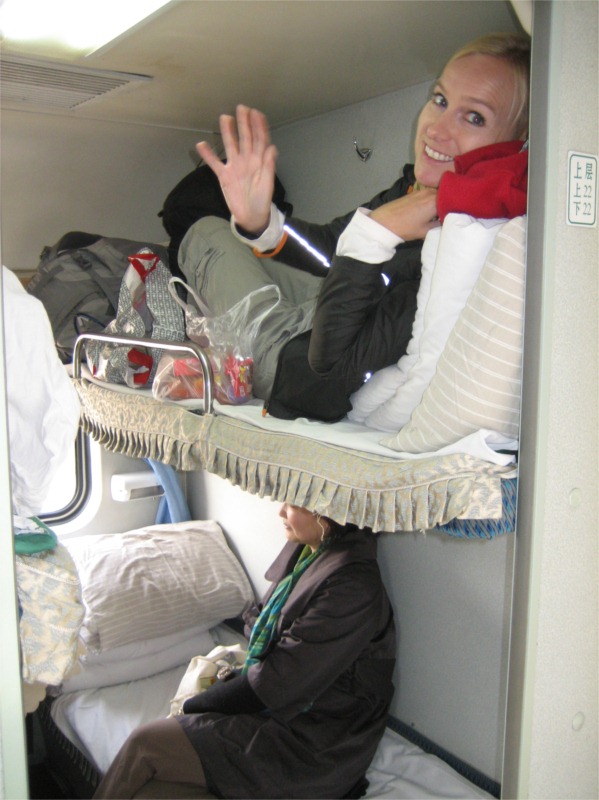
The train had double decker coaches and each floor had about twelve open cabins with four bunk beds – two lower and two upper.  We bought upper bunk tickets both because they were cheaper but also because we had heard that it would be easier to sleep in the top beds.

The train ride was twelve hours and went by pretty quickly.  It was very easy to sleep in the nice beds.  Even though they were a little hard they were way better than the buses in Thailand.  We found us in Xi’an at 06:20 in the morning – roaring to go.